How India's Competitive Programming Community Is Powering AI Training Data
Millions of engineers in India have spent years training their minds on the exact skills that AI code evaluation demands. This is the story of how a programming culture built around contests became one of the most important talent pools in the AI training data industry.
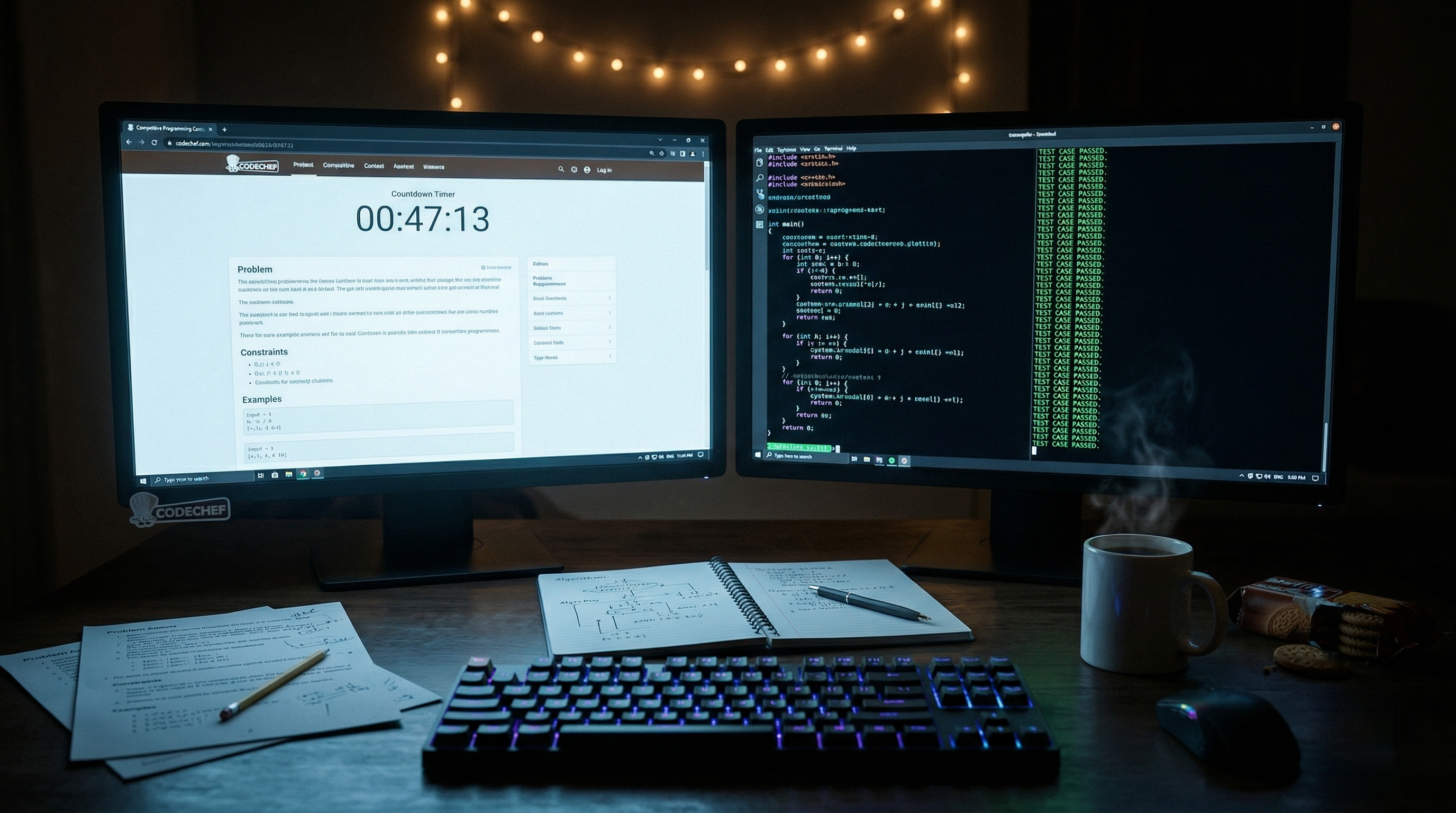
At 9 PM on a Saturday night, tens of thousands of programmers across India sit down at their computers and start solving problems under a two-hour timer.
They are not working. They are competing.
Codeforces contests, CodeChef long challenges, LeetCode weekly rounds: these are routines for a community of engineers that has grown over the past two decades into one of the largest and most technically disciplined programming communities in the world.
What most people outside the AI industry do not know is that this community, built around solving algorithmic puzzles for sport, has become a critical piece of the infrastructure behind how AI coding assistants are trained and evaluated.
The connection is not accidental. The skills that competitive programming builds are, almost perfectly, the skills that high-quality AI code evaluation requires.
What Competitive Programming Actually Is
If you have not encountered it before, competitive programming might sound like a niche hobby.
The reality is that it is a structured discipline practiced at enormous scale. In a competitive programming contest, you are given a set of problems with precise specifications. Each problem has exact input and output requirements, explicit constraints (this number can be up to 10 to the power of 18, that list can have up to a million elements), and a time limit for how fast your solution must run.
Your job is to write code that solves the problem correctly and efficiently, within the time limit.
You cannot just write something that works for the examples given. The judge runs your code against hidden test cases designed to catch every common mistake: boundary values, empty inputs, maximum constraints, duplicates, overflow cases, and edge cases that would break a careless implementation.
If your code handles everything correctly and runs fast enough, you get full marks. If it fails on a single hidden test case, you get zero.
This is not forgiving. It is precise. And years of practicing under these conditions builds something very specific in the people who do it: they start thinking about code in a fundamentally different way.
The Scale of the Community in India
India's involvement in competitive programming runs deep and wide.
CodeChef is an Indian success story. Founded in Mumbai in 2009 by Directi, it has grown into one of the three largest competitive programming platforms in the world, alongside Codeforces and LeetCode. It hosts major monthly contests with hundreds of thousands of participants, and its community skews heavily toward Indian engineering colleges.
Codeforces, the Russian-origin platform that is the global gold standard for competitive programming, has a large and active Indian user base. Indian programmers regularly appear in the top percentiles worldwide, and the country has produced multiple highly rated competitors.
ICPC, the International Collegiate Programming Contest, considers India one of its most active regions. IITs, NITs, BITS Pilani, and countless other institutions send teams to regional contests each year, and Indian teams regularly advance to the Asia-Pacific Regionals and beyond.
Beyond these formal channels, competitive programming preparation is woven into the culture of engineering education in India in ways that are different from most other countries. It is part of how students prepare for placement season. It is how ambitious programmers demonstrate ability beyond their academic credentials. It is a common topic of conversation in engineering college hostels.
The result is a talent pool of unusual depth and breadth, where serious algorithmic thinking is a mass activity rather than a specialist one.
Why These Skills Transfer Directly to AI Evaluation
When AI labs and training data companies look for people to evaluate code generated by AI models, they need evaluators who can do something specific: read a piece of code and accurately judge whether it is correct, efficient, and well-reasoned.
Competitive programmers have been training for exactly this for years, just in a different direction.
Reading problem specifications with precision
In competitive programming, reading a problem statement carefully is not optional. Missing a constraint, misunderstanding the output format, or overlooking a note about edge cases produces a wrong solution. Competitive programmers develop a habit of reading specifications slowly and carefully, looking for the exact conditions and limits that will determine what a correct solution needs to handle.
This translates directly to reading evaluation rubrics. Rubrics for AI code evaluation are essentially specifications for what "correct" and "good" mean. People who have spent years reading and interpreting algorithmic specifications approach rubrics with exactly the kind of precision that produces consistent, reliable annotation.
Thinking in edge cases first
For most people, testing code means checking whether it works on the obvious cases. For competitive programmers, this is the starting point, not the endpoint. After the obvious cases come the edge cases: what happens when n equals zero? When the list is empty? When all elements are identical? When the value is the maximum the data type can hold?
This instinct is not taught in a single session. It is built up over hundreds of hours of having solutions fail on test cases that the programmer did not think to check.
For AI code evaluation, this edge-case mentality is essential. Many AI-generated solutions look completely correct on normal inputs. The bugs reveal themselves on the boundary conditions that a non-careful evaluator would not think to consider.
Understanding efficiency without looking it up
Competitive programming has strict time limits. A solution that produces correct output but takes ten seconds will time out on a two-second limit. Competitive programmers learn to read code and immediately estimate its efficiency: is this an O(n log n) algorithm or O(n squared)? Will this approach work for a million elements, or will it slow to a crawl?
This skill is genuinely rare. Most developers have a general sense that efficiency matters, but few can look at a function and quickly assess whether it will scale. Competitive programmers do this instinctively.
For AI evaluation tasks that ask about code efficiency or whether an approach is appropriate for the stated scale of the problem, this background is hard to replace.
Debugging under pressure
Competitive programming is done on the clock. When a solution fails, you have limited time to diagnose why and fix it. This develops the ability to reason quickly about what a piece of code is doing, where the logic might break, and how to verify a hypothesis without running exhaustive tests.
For annotating AI agent trajectories, this matters. Evaluating whether an agent's debugging approach is reasonable requires understanding what good debugging looks like. Competitive programmers have strong, calibrated intuitions about this.
How This Plays Out in Practice
For AI training data projects, the way competitive programming expertise gets applied is usually structured.
At the base level, evaluators with solid competitive programming backgrounds handle direct code evaluation: reading AI-generated code, applying rubrics to assess correctness and quality, and flagging responses that need expert review. The combination of technical skill and rubric-following discipline makes for reliable, scalable annotation.
More experienced evaluators, often with both competitive programming achievements and professional software engineering experience, handle harder tasks: evaluating AI solutions to complex algorithmic problems, annotating agent trajectories on realistic coding tasks, and identifying subtle correctness issues that less experienced reviewers would miss.
Senior technical leads, often competitive programmers who have also worked in product engineering, handle rubric design, calibration, and quality auditing. They bridge the gap between the theoretical standards in the rubric and the practical reality of what AI-generated code actually looks like.
This layered structure works because the community has natural variation in experience and depth. Someone who is active on Codeforces at an intermediate level has already developed substantially stronger evaluation instincts than a general programmer. Someone who has competed at regional ICPC level has an even deeper toolkit. The talent pool supports multiple tiers.
The Broader Pattern
What is happening with India's competitive programming community is not unique to this moment in AI development. It is a continuation of a pattern that has always characterized how major technology inflection points interact with concentrated talent pools.
When the outsourcing industry grew in the 2000s, India's engineering education system and English proficiency made it a natural fit. When the mobile development boom happened, the same talent pool adapted quickly.
What is different about AI training data is how precisely the skill match works. Competitive programming does not just produce good general programmers. It produces people who think about correctness, edge cases, algorithmic efficiency, and precise specification in exactly the ways that code evaluation requires.
The AI labs and training data companies that have figured this out are building evaluation teams around this community not because it is convenient, but because the quality of the evaluation is substantially better.
Accurate training data is not an administrative task. It is a highly skilled technical activity. And in many respects, the competitive programming community was doing the cognitive preparation for it long before AI training data became an industry.
For Anyone Building an AI Training Data Team
If you are thinking about where to source evaluation talent for AI code tasks, a few things are worth knowing about this community.
The talent pool is deep and accessible. Competitive programming activity in India is spread across hundreds of engineering institutions, not concentrated in a handful of elite schools. This matters when you need to scale.
The skills are verifiable. Competitive programming ratings on platforms like Codeforces and CodeChef are transparent, globally comparable measures of problem-solving ability. An evaluator's Codeforces rating is meaningful information in a way that a resume claim is not.
The culture is already familiar with structured evaluation. People who have competed under strict rules and precise grading understand rubrics and consistent standards. They approach evaluation work as a serious technical activity, not a subjective judgment call.
And the time zone works. India's time zone covers a gap that is valuable for organizations operating across multiple regions, giving genuine overlap with both European and Asia-Pacific work hours.
The competitive programming community in India has been building exactly the right skills for exactly this moment. The AI industry is only beginning to fully realize how well that alignment works.
Writing about AI training, LLMs, and software engineering. Building AI products at Nomos Insights.
Continue Reading