Next.js 14: Complete Guide to App Router and Server Components
Master Next.js 14 with this comprehensive guide covering App Router, Server Components, and modern React patterns for building fast web applications.
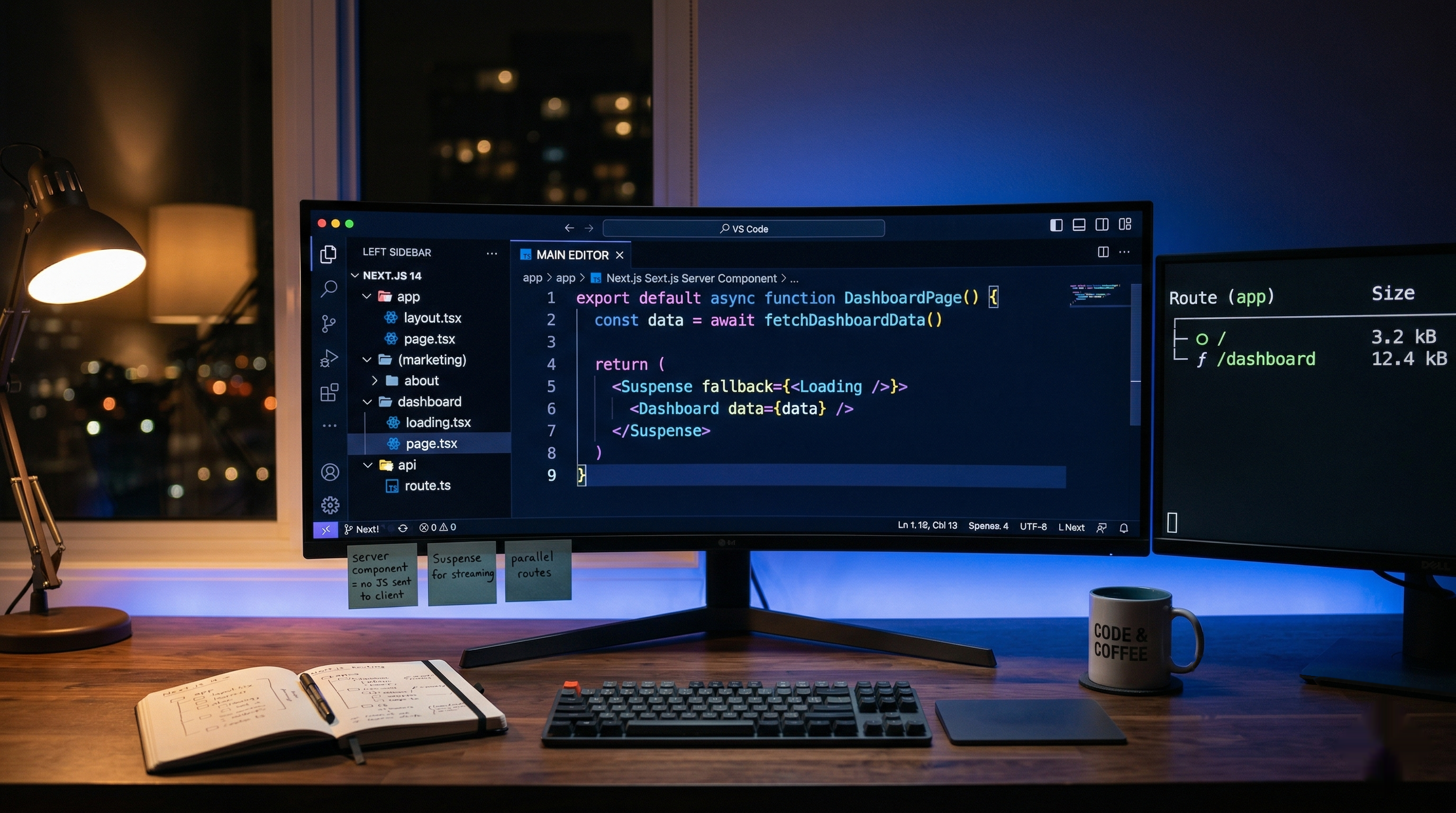
Introduction to Next.js 14
Next.js 14 represents a major evolution in React development. With the stable App Router and React Server Components, building fast, scalable web applications has never been easier.
This guide covers everything you need to know to get started with Next.js 14 and leverage its powerful features.
App Router Fundamentals
File-Based Routing
The App Router uses a file-system based approach:
app/
├── page.tsx          # / route
├── about/
│   └── page.tsx      # /about route
├── blog/
│   ├── page.tsx      # /blog route
│   └── [slug]/
│       └── page.tsx  # /blog/:slug route
└── layout.tsx        # Root layout
Layouts and Templates
Layouts persist across navigations and maintain state:
// app/layout.tsx
export default function RootLayout({
  children,
}: {
  children: React.ReactNode
}) {
  return (
    <html lang="en">
      <body>
        <nav>Navigation</nav>
        {children}
        <footer>Footer</footer>
      </body>
    </html>
  )
}
Server Components
Server Components are the default in the App Router:
Benefits:
- Zero client-side JavaScript for the component
- Direct database/API access
- Automatic code splitting
- Improved initial page load
// This runs on the server only
async function ProductList() {
  const products = await db.products.findMany()

  return (
    <ul>
      {products.map(product => (
        <li key={product.id}>{product.name}</li>
      ))}
    </ul>
  )
}
Data Fetching Patterns
Parallel Data Fetching
async function Page() {
  // These run in parallel
  const [users, posts] = await Promise.all([
    getUsers(),
    getPosts(),
  ])

  return (
    <div>
      <UserList users={users} />
      <PostList posts={posts} />
    </div>
  )
}
Streaming with Suspense
import { Suspense } from 'react'

export default function Page() {
  return (
    <div>
      <h1>Dashboard</h1>
      <Suspense fallback={<Loading />}>
        <SlowComponent />
      </Suspense>
    </div>
  )
}
Conclusion
Next.js 14 brings significant improvements to the React ecosystem. By understanding the App Router and Server Components, you can build faster, more efficient web applications.
Need help with your Next.js project? Contact us for expert guidance.
Writing about AI training, LLMs, and software engineering. Building AI products at Nomos Insights.
Continue Reading