Complete Guide to Enterprise AI Integration
Everything you need to know about integrating AI solutions into your enterprise systems. From chatbots to predictive analytics.
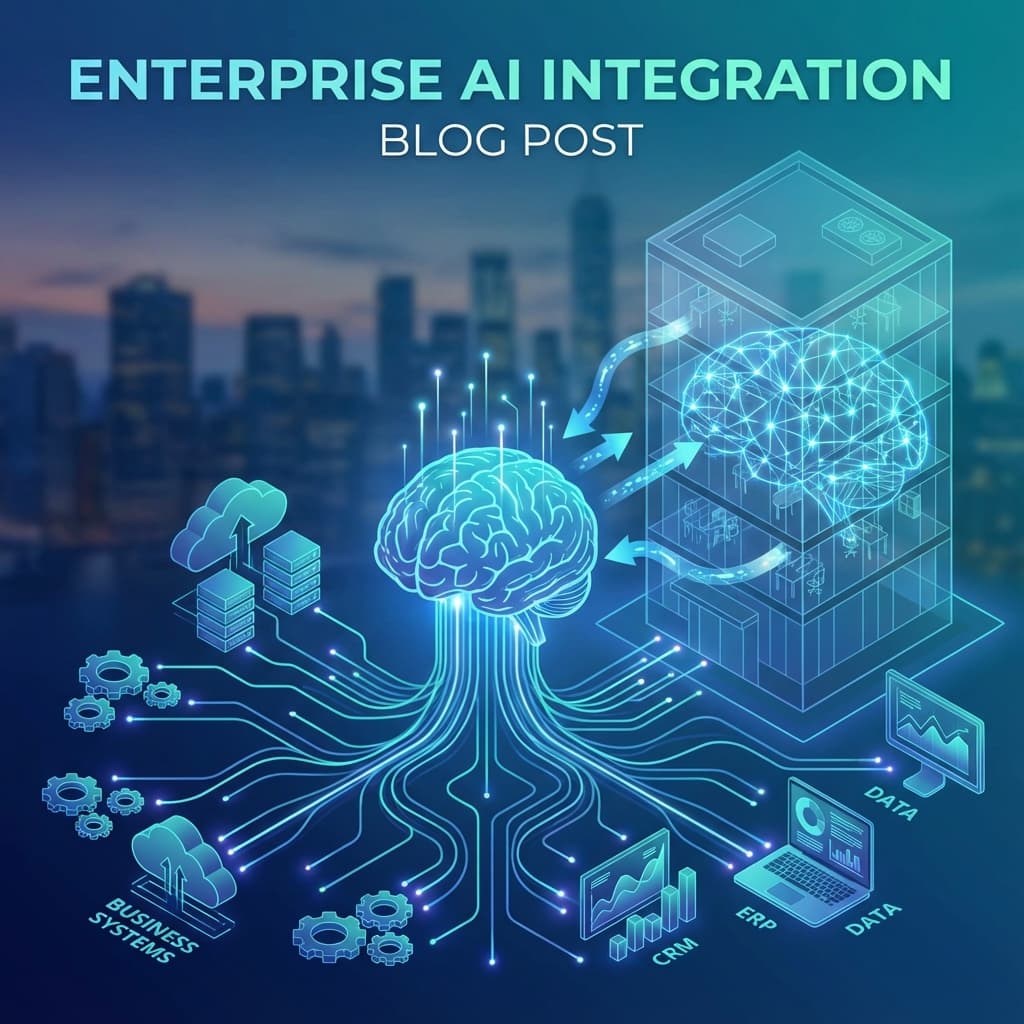
Why Enterprise AI Matters
Artificial Intelligence is no longer a competitive advantage. It's becoming a requirement for business survival. Organizations that successfully integrate AI into their operations are seeing remarkable results:
- 40% improvement in operational efficiency
- 35% reduction in customer service costs
- 25% increase in revenue through personalization
- 60% faster decision-making processes
This guide provides a comprehensive roadmap for integrating AI into your enterprise systems.
Understanding the AI Landscape
Types of AI Solutions for Enterprise
┌─────────────────────────────────────────────────────────┐
│                    ENTERPRISE AI                         │
├─────────────────┬──────────────────┬────────────────────┤
│   AUTOMATION    │   ANALYTICS      │   AUGMENTATION     │
├─────────────────┼──────────────────┼────────────────────┤
│ • RPA           │ • Predictive     │ • Copilots         │
│ • Workflow      │ • Prescriptive   │ • Assistants       │
│ • Document      │ • Diagnostic     │ • Recommendations  │
│   Processing    │ • NLP/Sentiment  │ • Creative Tools   │
└─────────────────┴──────────────────┴────────────────────┘
Maturity Levels
| Level | Description | Examples | |-------|-------------|----------| | 1 - Awareness | Understanding AI potential | Executive education, proof of concepts | | 2 - Active | Initial implementations | Department-level solutions | | 3 - Operational | Production AI systems | Integrated workflows | | 4 - Systematic | Organization-wide AI | Data-driven culture | | 5 - Transformational | AI-first operations | New business models |
Building the Foundation
Data Readiness
AI success depends on data quality. Assess your data across these dimensions:
The 5 V's of AI-Ready Data:
- Volume: Sufficient data to train models
- Velocity: Real-time data pipelines
- Variety: Structured and unstructured data
- Veracity: Accuracy and trustworthiness
- Value: Relevant to business objectives
# Example: Data quality assessment
class DataQualityAssessor:
    def assess(self, dataset):
        return {
            'completeness': self.check_completeness(dataset),
            'accuracy': self.validate_accuracy(dataset),
            'consistency': self.check_consistency(dataset),
            'timeliness': self.assess_timeliness(dataset),
            'uniqueness': self.check_duplicates(dataset),
            'validity': self.validate_formats(dataset)
        }

    def check_completeness(self, dataset):
        missing = dataset.isnull().sum() / len(dataset)
        return 1 - missing.mean()  # Score 0-1
Infrastructure Requirements
Compute Resources:
- GPU clusters for training
- CPU clusters for inference
- Hybrid cloud architecture
- Edge computing capabilities
Data Platform:
- Data lake for raw data
- Data warehouse for analytics
- Feature store for ML
- Vector database for embeddings
Key Integration Patterns
Pattern 1: AI-Enhanced Workflows
Augment existing processes with AI capabilities:
graph LR
    A[User Input] --> B[Business Logic]
    B --> C{AI Decision Point}
    C -->|Low Confidence| D[Human Review]
    C -->|High Confidence| E[Automated Action]
    D --> E
    E --> F[Output]
Example Use Cases:
- Automated invoice approval with exceptions
- Resume screening with human final decision
- Fraud detection with analyst investigation
Pattern 2: AI-First Applications
Build applications where AI is the core value:
- Intelligent search and discovery
- Personalization engines
- Predictive maintenance systems
- Conversational interfaces
Pattern 3: Embedded AI
Integrate AI into existing applications:
// Example: AI widget embedding
class AISearchWidget {
  constructor(config) {
    this.apiEndpoint = config.endpoint;
    this.container = config.container;
  }

  async search(query) {
    const response = await fetch(this.apiEndpoint, {
      method: 'POST',
      body: JSON.stringify({
        query,
        context: this.getUserContext()
      })
    });

    const results = await response.json();
    return this.renderResults(results);
  }
}
Implementation Roadmap
Phase 1: Assessment (Weeks 1-4)
Activities:
- Inventory current AI initiatives
- Assess data readiness
- Identify high-value use cases
- Evaluate build vs. buy options
Deliverables:
- AI opportunity assessment report
- Data readiness scorecard
- Prioritized use case backlog
- Technology recommendations
Phase 2: Foundation (Months 2-4)
Activities:
- Establish data governance
- Deploy AI infrastructure
- Build initial data pipelines
- Train core team
Key Milestones:
- [ ] Data platform operational
- [ ] MLOps pipeline established
- [ ] First model in staging
- [ ] Team certifications complete
Phase 3: Pilot (Months 4-6)
Focus Areas:
- Implement first use case
- Establish feedback loops
- Measure business impact
- Document learnings
Phase 4: Scale (Months 6-12)
Expansion Activities:
- Roll out successful pilots
- Add new use cases
- Build center of excellence
- Establish AI review board
Governance and Ethics
AI Governance Framework
┌─────────────────────────────────────┐
│         AI Ethics Board              │
├─────────────────────────────────────┤
│     Policies & Standards            │
├─────────────────────────────────────┤
│  ┌─────────┐ ┌─────────┐ ┌─────────┐│
│  │Fairness │ │Explaina-│ │Privacy  ││
│  │Testing  │ │bility   │ │Controls ││
│  └─────────┘ └─────────┘ └─────────┘│
├─────────────────────────────────────┤
│        Monitoring & Audit           │
└─────────────────────────────────────┘
Essential Policies
- Model Documentation: Requirements for all production models
- Bias Testing: Mandatory fairness assessments
- Human Oversight: Escalation procedures
- Data Privacy: Compliant data handling
- Audit Trail: Decision logging requirements
Measuring Success
Business Metrics
Track impact on business objectives:
| Metric Category | Example Metrics | |-----------------|-----------------| | Efficiency | Time saved, automation rate | | Quality | Error reduction, accuracy | | Revenue | Conversion improvement, upsell | | Cost | Cost per transaction reduction | | Experience | NPS improvement, resolution time |
Technical Metrics
Monitor model and system performance:
# Example: Model monitoring
class ModelMonitor:
    def track(self, model_id, predictions, actuals):
        metrics = {
            'accuracy': calculate_accuracy(predictions, actuals),
            'precision': calculate_precision(predictions, actuals),
            'recall': calculate_recall(predictions, actuals),
            'latency_p99': get_latency_percentile(99),
            'drift_score': detect_drift(predictions)
        }

        if metrics['drift_score'] > threshold:
            self.alert_team('Model drift detected', model_id)

        return metrics
Common Pitfalls and Solutions
Pitfall 1: Solving the Wrong Problem
Solution: Start with business problems, not AI capabilities
Pitfall 2: Ignoring Change Management
Solution: Invest equally in people and technology
Pitfall 3: Perfect Data Obsession
Solution: Start with available data; improve iteratively
Pitfall 4: Neglecting Operations
Solution: Build MLOps capabilities from day one
Pitfall 5: Underestimating Governance
Solution: Establish policies before scaling
Conclusion
Successful enterprise AI integration requires more than technology. It demands organizational transformation. The companies that thrive will be those that:
- Start with clear business objectives
- Build robust data foundations
- Invest in people and processes
- Govern AI responsibly
- Iterate and scale systematically
The journey is challenging but the rewards are worth it: efficiency, innovation, and competitive advantage make it essential.
Ready to start your AI journey? Contact our team for a strategic assessment.
Writing about AI training, LLMs, and software engineering. Building AI products at Nomos Insights.
Continue Reading